
CUE-401
A bifunctional IL-2 and TGF-β for autoimmune disease
Autoimmune Disease – A Significant Unmet Medical Need
Autoimmune and inflammatory diseases remain among the most challenging areas in medicine due to their complex, multifactorial nature, and the immune system’s intricate self-regulation. While available therapies have improved outcomes for many patients, they primarily focus on suppressing immune activity or blocking inflammatory pathways after disease onset. These approaches may not address the underlying loss of immune tolerance that drives autoimmune disease.
Restoring Immune Tolerance
The immune system is remarkably precise. When functioning properly, it distinguishes between foreign threats and the body’s own healthy tissues. A specialized population of immune cells known as regulatory T cells (Tregs) characterized by expression of FOXP3+1 serve as key regulators of immune tolerance by preventing inappropriate immune responses against self-tissues.
When immune tolerance is disrupted, pathogenic immune responses can emerge and contribute to the development and progression of autoimmune disease. Chronic inflammation can further impair Treg function and stability while promoting the expansion and activity of pro-inflammatory effector T cells, reinforcing a cycle of immune dysregulation.
Restoring immune balance may therefore require both strengthening regulatory pathways and reducing pathogenic inflammatory responses. Therapeutic approaches that promote immune tolerance have the potential to address the underlying drivers of autoimmune disease rather than simply controlling its downstream consequences.
The importance of Tregs in controlling autoimmunity and maintaining immune homeostasis has gained increasing recognition across the scientific community. The 2025 Nobel Prize in Physiology and Medicine highlighted foundational discoveries that established the critical role of FOXP3+ regulatory T cells in keeping the immune system in balance.
At Cue, we hypothesized that simultaneously engaging two key immune signaling pathways – interleukin 2 (IL-2) and transforming growth factor beta (TGF-beta) – could have meaningful effects on regulatory T cell biology. This concept was further externally validated in a recent paper published in Nature [Sun et al. 2026 Nature Reviews].
CUE-401: A Differentiated IL-2 and TGF-beta Bifunctional Cytokine
CUE-401 is an investigational molecule with a proposed mechanism of action that combines affinity-attenuated IL-2 and TGF-beta cytokines, delivering these two key Treg-supporting signals within a single molecule. By attenuating both signaling components, CUE-401 is believed to limit signaling through either pathway alone while potentially enabling coordinated engagement when both receptors are present on the same target cell.
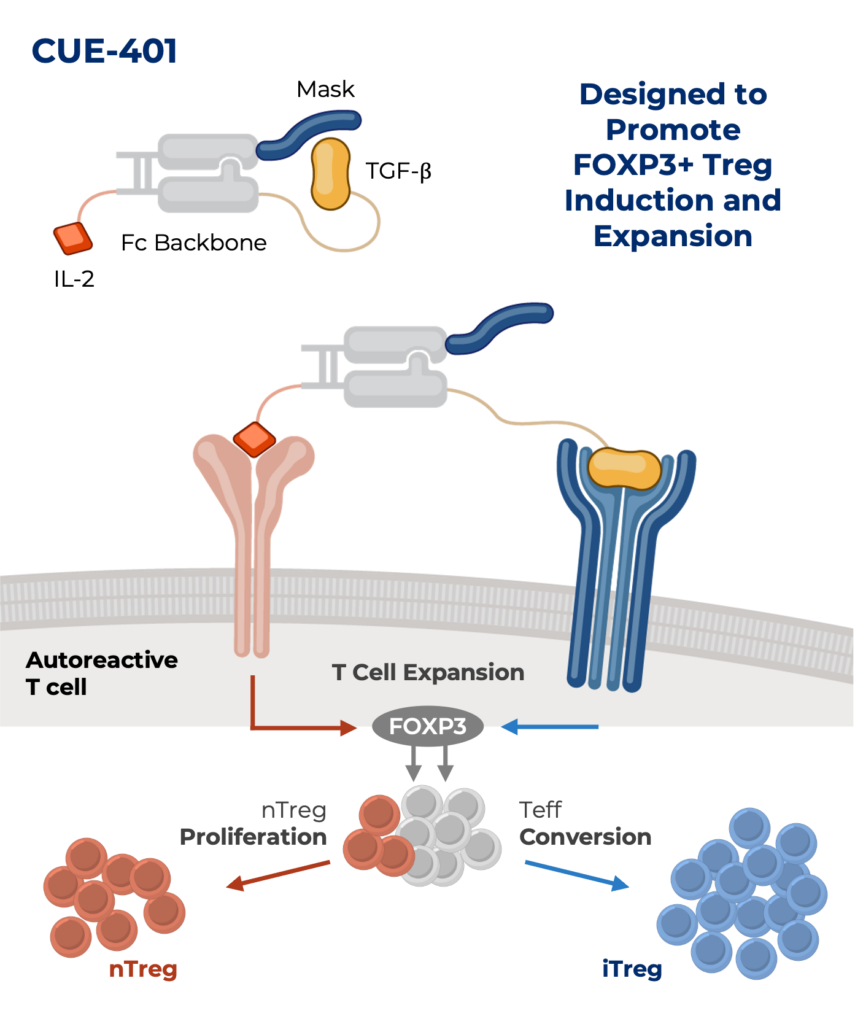
The design of CUE-401 is shown in the figure above. The molecule consists of an affinity-attenuated IL-2 domain on an Fc backbone paired with an attenuated TGF-beta domain integrated into a single construct.
The pre-clinical study data generated to date provides encouraging evidence that CUE-401 produces the intended biological effects for which it was designed. CUE-401 has shown broad in vivo efficacy across immune-mediated disease models including autoimmune gastritis, experimental autoimmune encephalomyelitis (EAE), and graft-versus-host disease (GVHD). In
in vivo models of autoimmune gastritis CUE-401 has shown preservation of tissue architecture, attenuated and delayed disease progression in models of EAE and GVHD respectively and improved overall survival in a model of GVHD.
CUE-401 has also shown broad suppression of pro-inflammatory cytokines, including IL-17, GM-CSF, interferon-gamma, and TNF-alpha in vivo model of GVHD. These findings suggest the generation of a more tolerogenic immune environment and support the proposed mechanism of action.
CUE-401 in the Clinic
CUE-401 is expected to enter the clinic through a first-in-human Phase 1 study by year-end 2026.
FOXP3+ is a master regulatory transcription factor required for the development and function of regulatory T cells, also known as Tregs.
Peterson et al 2018 J of Autoimmunity; Girgis N et al., 2025, CUE-401: A Novel TGF-beta/IL-2 Fusion Protein for the Induction Expansion of FOXP3+ Regulatory T Cells.