
CUE-221
Novel dual-mechanism-of-action (MOA) anti-IgE
IgE Therapies and Unmet Need
Immunoglobulin E (IgE) is a clinically validated, therapeutic target. Monoclonal antibodies that target IgE transformed the treatment of IgE-mediated allergic diseases. Despite this advance, significant unmet need remains, particularly in diseases characterized by very high IgE levels.
Food allergy illustrates this challenge. More than 30 million Americans are affected, and the prevalence of food allergy continues to rise. The disease imposes a substantial burden on patients and families, with many individuals remaining at risk for severe, potentially life-threatening allergic reactions despite allergen avoidance and available therapies.
A distinguishing feature of food allergy is its high IgE burden, with patients exhibiting markedly elevated baseline IgE levels. This presents a challenge for therapies that rely solely on neutralizing circulating IgE, as higher IgE concentrations require greater drug exposure to achieve and maintain suppression of free IgE. For current marketed therapies, these pharmacologic constraints have translated into frequent dosing requirements, and some patients remain ineligible for treatment because their baseline IgE levels and body weight fall outside the approved dosing table.
As a result, there remains an opportunity for therapies that address IgE biology more comprehensively. In addition to neutralizing existing free IgE as with current marketed therapies, suppressing ongoing IgE production could provide deeper and more sustained reductions in IgE, potentially expanding treatment options for patients with the greatest IgE burden.
CUE-221 Proposed Mechanism of Action: A Differentiated Approach to Targeting IgE
CUE-221 is a novel anti-IgE antibody engineered with a proposed differentiated dual mechanism of action designed to address both existing IgE and the biology that drives continued IgE production.
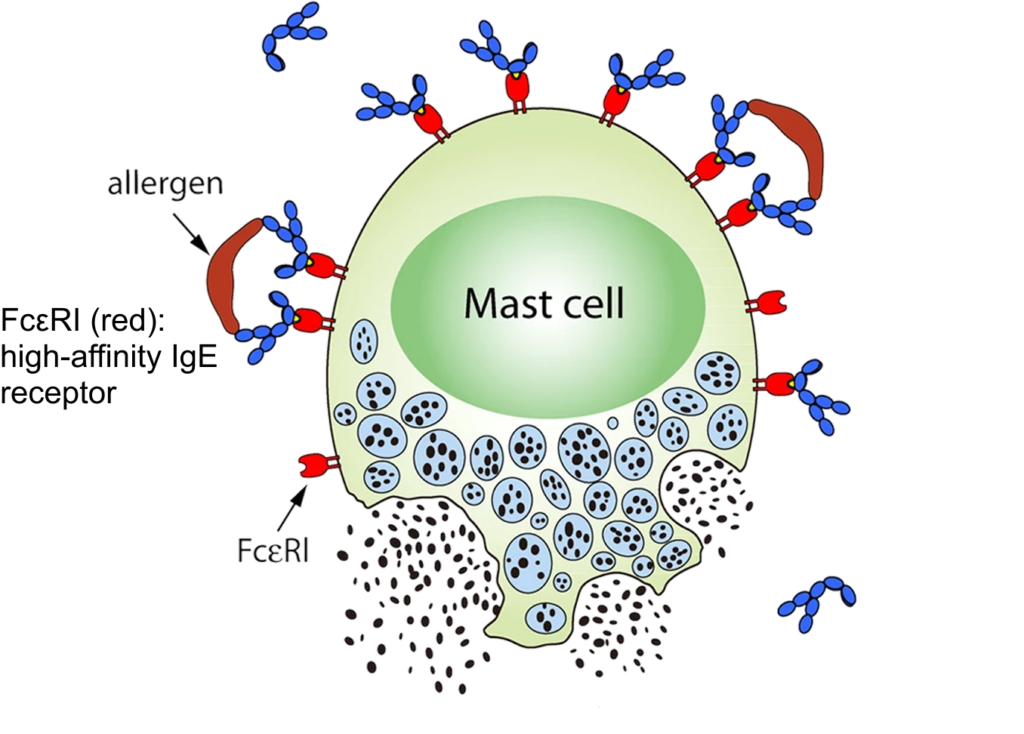
Like first-generation anti-IgE therapies, CUE-221 binds to free IgE, preventing its interaction with the high-affinity IgE receptor (FcεRI) on mast cells and basophils (see figure 1 below). This blocks IgE-mediated allergic signaling while facilitating the removal of circulating IgE.
Importantly, CUE-221 was also designed to preserve signaling through the low-affinity IgE receptor, CD23 (FcεRII) (Kuo et al. J Clin Invest. 2022). CD23 serves as part of the body’s natural feedback mechanism for regulating IgE homeostasis, helping limit new IgE production when circulating IgE levels are elevated (see figure 2 below).
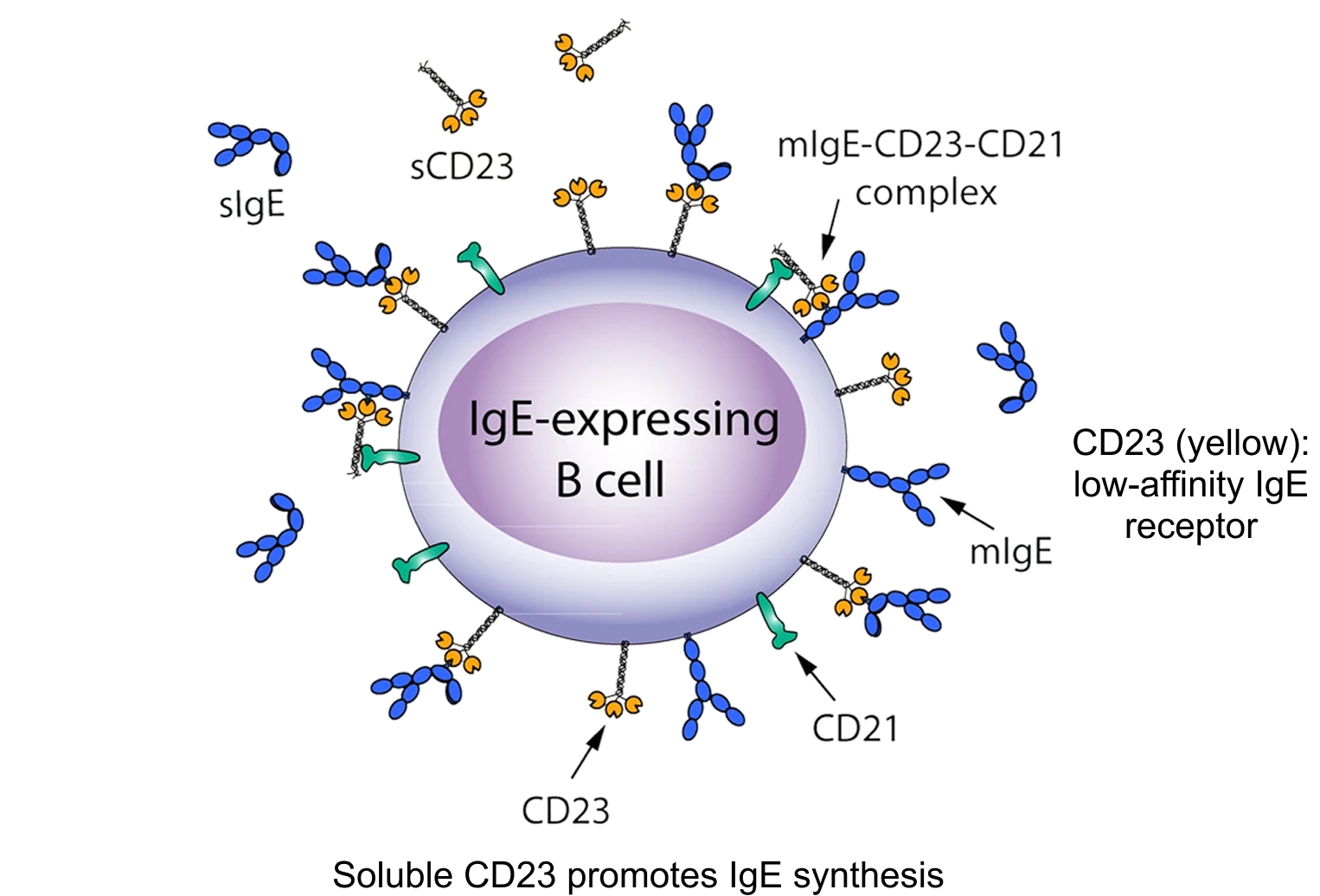
By preserving CD23 function while neutralizing free IgE, CUE-221 has the potential to both reduce existing circulating IgE and maintain the body’s natural ability to suppress ongoing IgE production. This differentiated mechanism is designed to potentially achieve deeper and more durable control of IgE biology than approaches based solely on neutralizing circulating IgE.
CUE-221 in the Clinic
CUE-221 was engineered with the goal of achieving deep and sustained suppression of free IgE while preserving the body’s natural regulation of IgE production. Early clinical study data have shown rapid, profound, and durable suppression of free IgE, with pharmacodynamic findings that are consistent with CUE-221’s proposed differentiated mechanism of action.
In the Phase 1 single ascending dose study in patients with Chronic Spontaneous Urticaria (CSU) (NCT03632291), a single administration of CUE-221 reduced free IgE to below the assay’s limit of detection by first measurement 1-week after the single dose. At the higher dose levels studied, free IgE remained below detectable levels for the duration of study at 14 weeks following a single dose (Kuo et al. J Clin Invest. 2022).
These findings suggest rapid, profound, and sustained suppression of free IgE following a single administration and provide Phase 1 clinical data supporting CUE-221’s differentiated mechanism of action. The depth and durability of IgE suppression observed in the study suggest the potential for sustained biological activity over an extended period (Kuo et al. J Clin Invest. 2022).
An ongoing randomized Phase 2 study in patients with CSU is being conducted in China by CUE-221’s licensor. (www.chinadrugtrials.org.cn)
The study is designed not only to evaluate efficacy versus placebo but also to directly benchmark performance against the current anti-IgE standard of care, with 145 patients randomized across three CUE-221 dose groups. Patients are treated for up to 16 weeks, with follow-up extending through week 36. The primary endpoint is complete hive symptom score, defined as HSS7 of 0, or no hives, at week 12.
Figures 1, 2: “Adapted from Wright et al., “Structural and Physical Basis for Anti-IgE Therapy,” Scientific Reports 5, 11581 (2015). Licensed under CC BY 4.0 (https://creativecommons.org/licenses/by/4.0/).”